
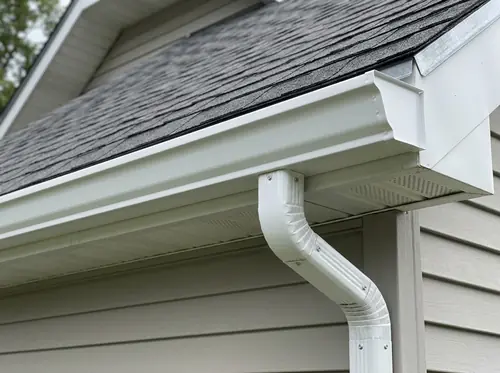
Where gutters leak
| Spot | What fails | Fix |
|---|---|---|
| Inside and outside corners | Sealant in the miter | Clean, rivet, reseal |
| Seams on sectional gutters | Connector sealant | Reseal or replace with seamless |
| End caps | Sealant at the crimp | Reseal, re-crimp |
| Outlets | Seal around the drop | Reseal or replace the outlet |
| Holes and rust spots | Corrosion, old fasteners | Patch or replace the section |
| Behind the gutter | Missing drip edge | Add drip edge or gutter apron |
Why joints fail sooner here
New Orleans has a humid subtropical climate with hot summers and about 62.5 inches of precipitation a year. Gutters spend long stretches wet, then bake in strong sun. Sealant shrinks, cracks and lets go. Debris that holds water in the trough keeps the joints soaking even longer.
How a proper reseal is done
- Clear debris from the joint and the trough around it.
- Scrape off old sealant and clean the metal until it is bare and dry.
- Tighten or add rivets so the joint cannot flex.
- Apply gutter sealant inside the joint, tooled smooth so water runs over it.
- Let it cure, then test with a hose.
Why the wood matters
A leak that has dripped for a season can rot the fascia and the end of the rafter behind it. The LSU AgCenter says Formosan subterranean termites seek water from roof leaks and blocked gutters, so a long-running drip is worth checking for more than rot. A good repair includes pushing a screwdriver into the wood behind the leak. See fascia and soffit repair.
Leaking or overflowing?
From the ground, overflow and a leak can look the same. Watch in a storm, or run a hose:
- Water over the front lip along the run: overflow. See 6-inch gutters.
- Water from one point, usually a corner, seam or end cap: a leak.
- Water behind the gutter, running down the fascia: drip edge or gutter height.
What to ask
- Where exactly is it leaking, and why?
- Is the gutter moving at the joint, and will you fix that too?
- Is the wood behind it sound?
- What is the warranty on the repair?
Leaks and mosquitoes
A leaking joint often means water is standing in that part of the gutter. Standing water breeds mosquitoes, and the city's mosquito board lists clogged gutters among the places they lay eggs. Fixing the leak and the pitch together keeps the gutter draining.