
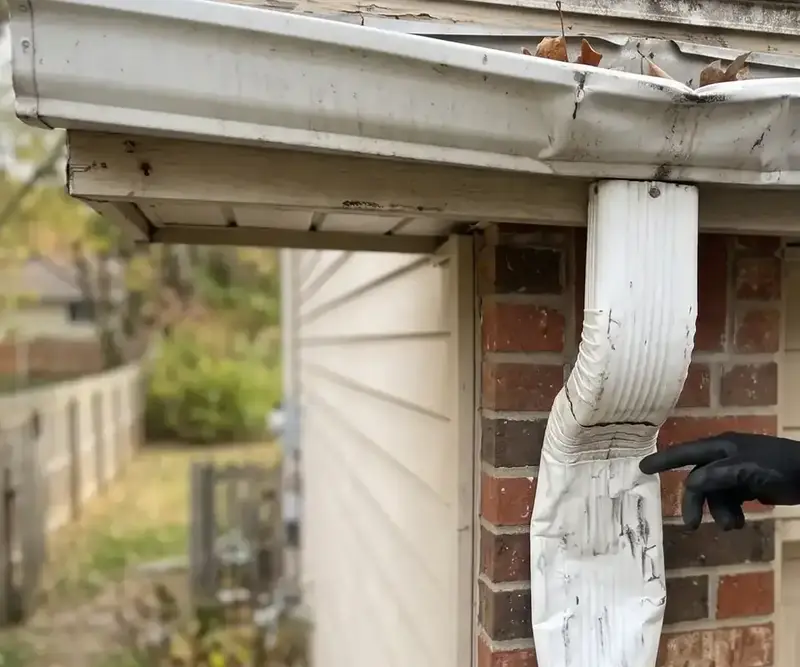
Common downspout problems
| Problem | Sign | Fix |
|---|---|---|
| Clogged elbows | Overflow at the top in a storm | Flush or take apart |
| Crushed or split section | Water spraying out partway down | Replace the section |
| Loose straps | Downspout swings or leans | Re-strap into solid wood or anchors |
| Missing extension | Water at the base of the wall | Add an extension or splash block |
| Emptying under the house | Wet ground between piers | Turn the outlet out from the house |
| Underground pipe backing up | Water bubbling at the downspout base | Test, clear or disconnect |
| Too small | Overflow at the outlet when clean | Upsize to 3x4 |
Why the outlet end matters so much
Much of New Orleans sits at or below sea level. In a heavy rain, the ground is soaked and the street drains fill. Water dumped at the base of a wall or under a raised house stays there. Damp ground under a house keeps the framing wet, and the LSU AgCenter notes that moist conditions favor Formosan termites.
Disconnecting old underground pipes
Many older houses have downspouts piped into the ground. The Sewerage and Water Board's downspout brochure walks through disconnecting a downspout from an underground pipe: secure the downspout, add a splash block to carry the water away from the house, and keep the gutters clean. A contractor can cap the old pipe and fit an elbow and splash block. See drain line repair.
Strapping for wind
Downspouts catch wind. Two straps minimum, more on two-story and raised houses, fastened into solid wood or masonry anchors. Check them before hurricane season. See the hurricane season checklist.
What to ask
- Is this a clog, a damaged section or a sizing problem?
- Where will the water go once the downspout is fixed?
- Should the old underground pipe be tested, cleared or disconnected?
Downspouts on raised houses
Raised houses have the longest downspouts in the city and the most reason to get the bottom right. A downspout that empties between the piers keeps the ground under the house wet. Turn it out, add an extension if needed, and set a splash block that slopes away. The LSU AgCenter notes that moist conditions favor termite colonies.